
Supporting Indigenous Legal Rights in Canada
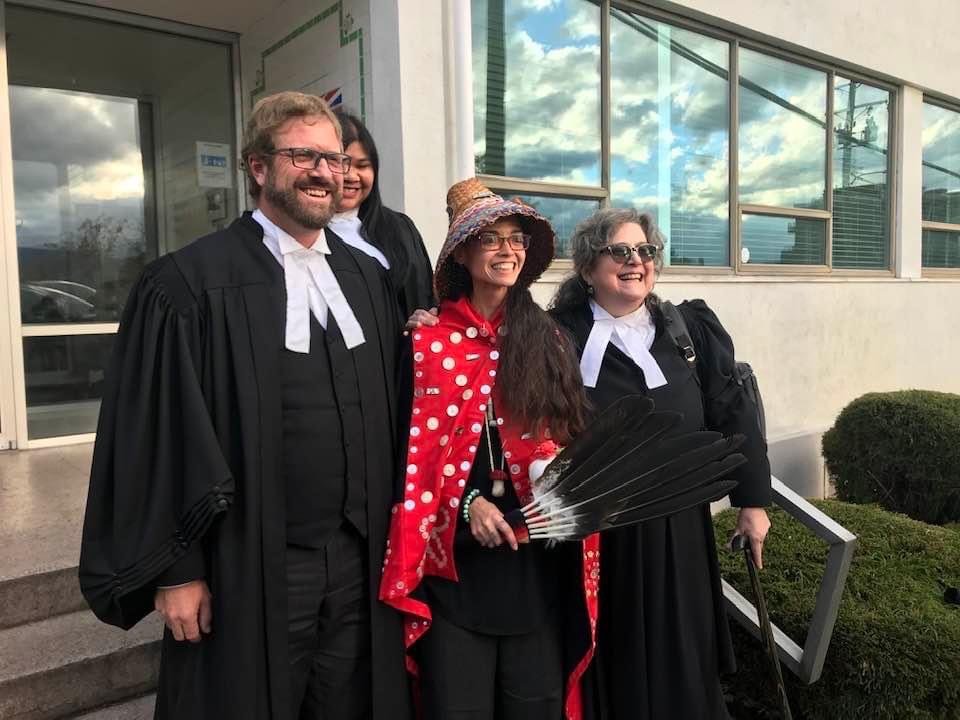
Photo: The Red Cedar Advocacy Centre has supported the legal defense of a number of Indigenous land defenders protecting territory and challenging natural-resources authorizations, including Kwakwaka'wakw land guardian Rainbow Eyes, shown at her trial in Nanaimo with defense counsel Ben Isitt, Michelle Silongan and Elisabeth Strain.
The Red Cedar Advocacy Centre in Lekwungen Territory (Victoria, British Columbia, Canada) is working to reduce barriers to justice by offering legal services on a free or pay-what-you-can basis. They work with low-income community members, Indigenous peoples, people of color, and other people from equity-seeking groups. We spoke with Red Cedar’s Managing Director, Ben Isitt, about their work with Indigenous climate defenders.
Repression of climate activism is surging around the world. Can you briefly explain what this trend has looked like in Canada over the last few years?
Repression of climate activism has taken different forms at different places around the globe. In Canada, the response has been uneven, with legal penalties generally being more lenient in comparison with trends we are seeing in the UK and elsewhere. However, there is evidence of a hardening of the approach of Canadian police, prosecutors, and judges. For example, climate activists in Quebec have faced prosecution demands for more than a year of imprisonment for non-violent civil disobedience.
While the legal defence teams have so far avoided these kinds of extreme sentences, we can expect positions to continue to harden in the years ahead, as the governments of Canada and the provinces double-down on support for pipelines and other fossil fuel projects — and as Indigenous peoples and others climate defenders continue to resist these projects.
What role has Red Cedar played in defending climate defenders, and keeping space open for freedom of expression and protest?
Red Cedar Advocacy Centre has defended a number of climate defenders in Canada, from pipeline opponents in Coast Salish, Secwépemc, and Nisga’a territories to citizens engaging in civil disobedience from Vancouver to Ottawa and many points in between.
Red Cedar’s legal team has also advanced strategic legal actions to protect freedom of expression and protest in Canada. This includes bringing applications to challenge court injunctions, securing bail variations for climate defenders to uphold the presumption of innocence and remove onerous release conditions, and advancing civil litigation to obtain accountability for police misconduct against climate defenders.
Red Cedar is based in Lekwungen Territory. Please describe your approach to Indigenous access to justice.
Indigenous access to justice is a cornerstone of Red Cedar Advocacy Centre’s work. We work closely with Indigenous peoples in our local area, on resource stewardship initiatives as well as broader legal support for Indigenous land defenders. This includes supporting efforts to restore and implement Indigenous legal orders, advancing assertions of Indigenous interests to natural resources, protecting Indigenous cultural rights, and providing legal representation for Indigenous peoples on matters relating to housing, governance, and human rights.
In the context of fossil fuel expansion and natural resource exploitation in Canada, our work involves upholding Indigenous interests, supporting the application of Indigenous laws in natural-resources disputes, and providing direct legal support for Indigenous land defenders who face legal consequences for defending their resources and territories.
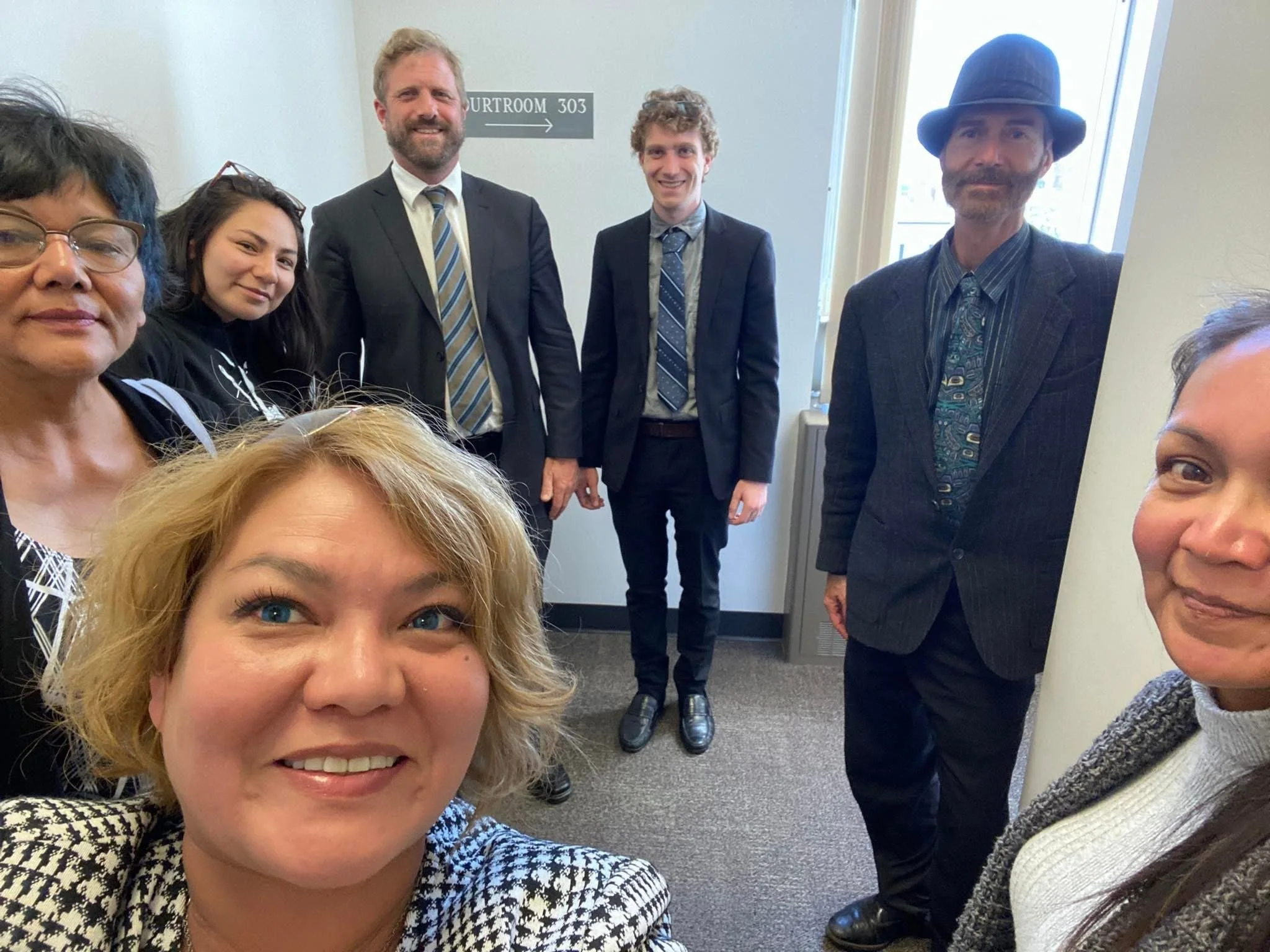
Photo: Members of Red Cedar’s legal team support W̱SÁNEĆ matriarchs Sheri and Vanessa Claxton in their efforts to protect their territory and obtain accountability from their tribal government and the Government of Canada.
The Canadian government is seeking to reduce its export reliance on the US, and is moving away from reducing emissions and towards boosting oil and gas production. How are climate defenders and lawyers preparing for this shift?
Climate defenders and movement-aligned lawyers in Canada are preparing for the shift in government policy in diverse ways. Climate defenders are ramping up opposition to new pipeline and fossil-fuel projects, including civil disobedience in rural and urban areas and other tactics aimed at building a movement for ongoing climate leadership.
Movement-aligned lawyers are preparing for an intensification of conflict between climate defenders and the Canadian state by establishing legal-defence systems that are responsive to local conditions, by sharing best practices on legal strategies across the country, and by training a new generation of movement lawyers to prepare for the legal battles ahead. Movement lawyers are also preparing to challenge pipeline permits and other fossil fuel authorizations in court, alongside providing direct legal support for climate defenders.
Why does your work matter to people who don't see themselves as climate defenders?
Red Cedar’s work matters to people who don’t see themselves as climate defenders because the consequences of runaway climate change impact everyone — as do violations of civil liberties and human rights by police, resource companies and state agencies.
Our legal support for climate defenders in criminal and civil proceedings helps reduce barriers to participation by Indigenous peoples, the climate-justice movement and other social movements, strengthening advocacy for climate leadership and land stewardship in Canada and the provinces.
Our efforts to obtain accountability for police misconduct in connection with environment protests and Indigenous land-defence efforts helps to strengthen the underpinnings of democracy in Canada and beyond — providing a beacon of justice to counteract the global upsurge of totalitarianism.