
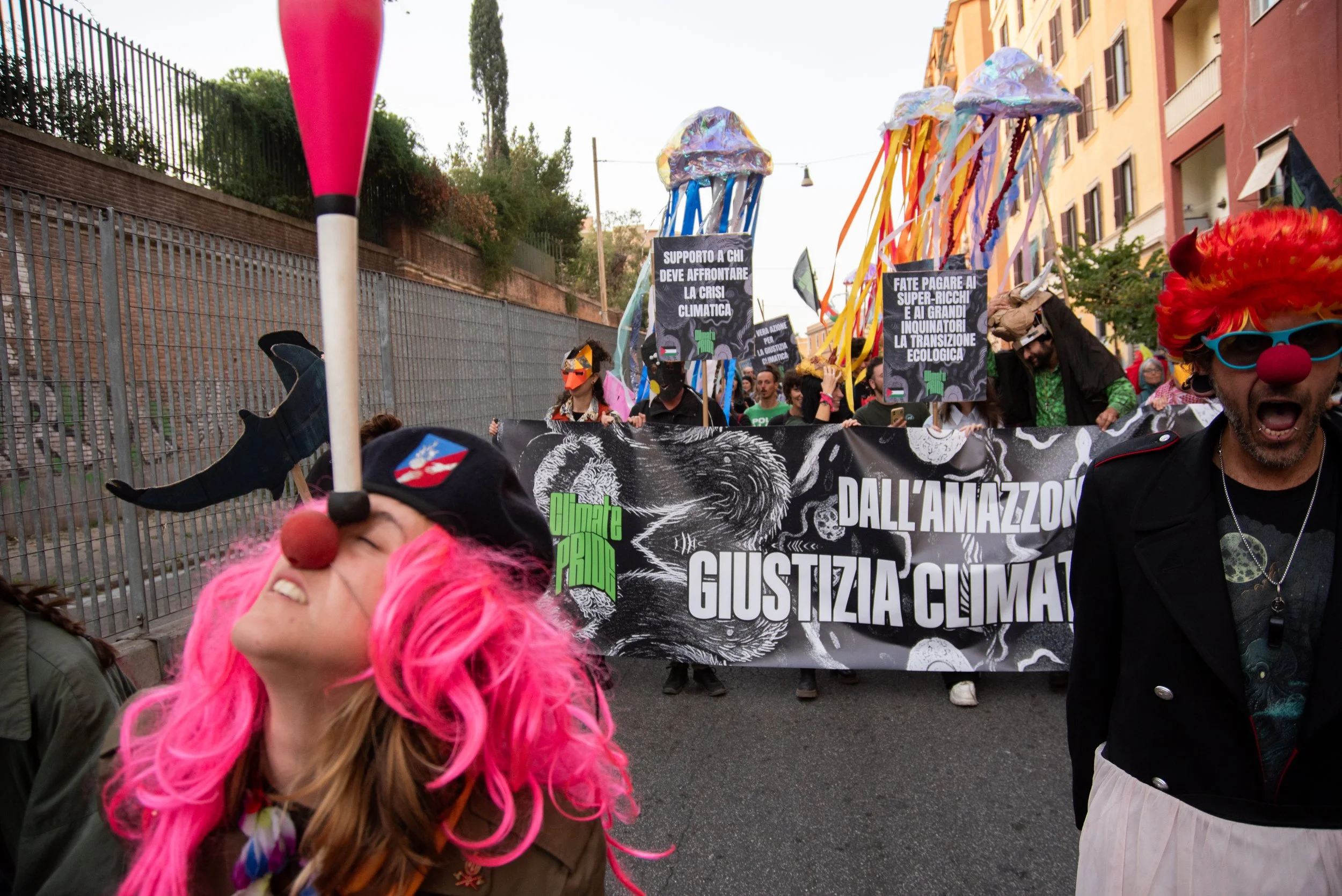
Participants march in a climate pride demonstration in Rome, Italy in November 2025. Photo credit: CFFC Roma
A Sud is an independent Italian association that investigates the root causes of environmental crises and holds those responsible accountable. Global Climate Legal Defense spoke with Marica Di Pierri, spokesperson for A Sud, journalist, and human rights researcher about their work in defending climate defenders in Italy.
Italy’s commitment to climate action is a bit different from many of its EU peers. Can you explain?
Italy has seen a gradual decline in the political priority given to climate action. The energy crisis that followed Russia’s invasion of Ukraine was used primarily to relaunch the role of gas, with the stated ambition of turning Italy into an energy hub for the Mediterranean, rather than to genuinely accelerate the phase-out of fossil fuels. Even the change in terminology is telling: in 2022, the Ministry for Ecological Transition became the Ministry for the Environment and Energy Security. Of course, this is not just a matter of naming, but it clearly reflects a shift in public discourse from “transition” to “security of supply”.
Against this backdrop, the structural relationship between the Italian State and ENI carries enormous weight. ENI, Italy’s leading oil and gas company and one of Europe’s largest energy groups, is also among the fossil fuel companies that have contributed most to global emissions, according to the Carbon Majors Database. In the period following the Paris Agreement, from 2016 to 2022, ENI ranked as the ninth-largest investor-owned company in the world in terms of emissions associated with the production and use of the fossil fuels it sold, accounting for around 1.75 billion tonnes of CO₂ equivalent.
The Italian State retains de facto control of the company through the Ministry of Economy and Finance and Cassa Depositi e Prestiti, a public development bank. In our view, ENI’s size and strategic role end up exerting a profound influence on national energy policy. This overlap is particularly evident when it comes to gas: while Italy aims to become a Mediterranean energy hub, ENI continues to regard oil and gas as a pillar of its strategy and expects gas to account for more than 60% of its upstream production by 2030. We are also talking about a company that recorded enormous profits during the energy crisis, with net profit reaching a peak of more than €13 billion in 2022, according to figures published by ENI itself.
These dynamics are compounded by a broader cultural and media problem. A significant part of the political right has progressively pushed the climate crisis out of the public debate, or framed it primarily in terms of the alleged costs and constraints of the transition. Narratives in mainstream media that oppose the transition are becoming prominent precisely as journalistic attention to the impacts of the climate crisis is declining.
The result is a paradox: the effects of global heating are becoming ever more visible. However, in Italian public debate, the transition is often portrayed as an economic and social threat, rather than as a necessity and an opportunity for justice.
What are the unique and concrete needs of climate defenders in Italy?
In recent years, climate activists in Italy have been among the first targets of the government’s increasingly restrictive approach to dissent. The so-called “eco-vandals” law, adopted by decree in 2024, introduced new and severe penalties for protest actions involving cultural heritage sites.
But repression does not operate through criminal proceedings only. There is a growing use of administrative measures such as expulsion orders, which prevent individuals stopped during a demonstration from returning to a particular location for up to four years, even without a criminal conviction. We have also seen more DASPO-style banning orders that restrict individuals from specific public spaces, and more financial penalties. Protest can become extremely costly even before a case reaches a courtroom, through administrative fines, legal expenses, restrictions on freedom of movement, and repercussions on people’s personal and professional lives.
This is compounded by strong public stigmatization, fuelled by labels such as “eco-vandals”, “eco-thugs”, or even “eco-terrorists”, which contribute to delegitimizing those who engage in non-violent civil disobedience.
How does an ecosystem of climate lawyers, like the one CliDef is helping to grow with A Sud in Italy, help climate defenders?
It is essential to have access to legal support when charges are brought. Climate defenders also need a genuine protection ecosystem that is capable of intervening before, during, and after an action to provide preventive legal advice, criminal, and administrative defence. They also need the ability to challenge measures such as expulsion orders, support with legal costs, as well as psychological support and accompaniment for people subjected to prolonged judicial pressure.
A network of lawyers also makes it possible to pool expertise and strategies, and to identify when individual proceedings are part of a broader pattern of restrictions on civic space. Protecting climate defenders also means preventing the economic and psychological burden of repression from producing a chilling effect. People give up on mobilising not because their protest is illegitimate, but because the personal cost has become too high.

Police blockade a climate protest in front of the government building in Rome, Italy in December 2024. Photo credit: Ultima Generazione
In April of 2025, the Italian Council of Ministers endorsed stricter security rules that criminalize road and railway blockades, among other non-violent protest. What has been the effect of these rules on free expression and movement?
It is still difficult to quantify the extent to which the new measures are producing a deterrent effect, because there is no indicator capable of measuring how many people have decided not to take part in a mobilisation or protest out of fear of the consequences. But from what we observe, the chilling effect is real. Following the adoption of Law 80/2025, proceedings over road and railway blockades were immediately used against peaceful demonstrations: not only in the context of climate activism, but also in the trade union movement and, above all, during the large mobilisations in support of Palestine in autumn 2025.
In Bologna, for example, prosecutors requested penal orders against three trade unionists over the blocking of a road during a metalworkers’ demonstration; proceedings concerning blockades during pro-Palestine protests have already led lawyers and magistrates to raise questions about the compatibility of the new rules with constitutional rights.
What is most concerning, however, is that this process did not stop with the 2025 decree. In 2026, preventive police powers were expanded further, to the point of allowing, under certain circumstances, the preventive detention for up to twelve hours of people considered “potentially dangerous” in connection with a demonstration, alongside the extension of administrative and preventive measures. Amnesty International has warned of the risk that this could consolidate a model based not on establishing whether unlawful conduct has actually occurred, but on predicting the future “dangerousness” of those who protest.
For us, this marks a very serious shift in paradigm: from punishing an offence after it has allegedly been committed to the possibility of restricting personal freedom in advance on the basis of suspicion. This dynamic moves the State away from the logic of the rule of law and dangerously closer to a policing-based management of dissent. The message to society is clear: taking part in a protest can carry increasingly serious consequences. And it is precisely this message, even before convictions are handed down, that narrows civic space.
A Sud filed a lawsuit in 2021 against the Italian government for failure to take up the necessary actions to meet the Paris Climate Agreement targets. What is the symbolic and tangible value of taking on this type of lawsuit?
Giudizio Universale was the first climate case brought against the Italian State. More than 200 claimants, including individuals, minors, and associations, asked the Italian courts to recognise that inadequate climate policy is not simply a poor political choice, but can result in violations of fundamental rights.
Three years later, the first-instance judgment in 2024 did not examine the merits of the case and declared it inadmissible on the grounds of an absolute lack of jurisdiction — a position that has been called into question by more recent case law from the European Court of Human Rights. We of course appealed that decision, and in 2026 the appeal is still ongoing, although it is now approaching its final stages.
One of Italy’s longstanding problems is precisely the slowness of the justice system: in climate litigation, time is a substantive variable, not merely a procedural one. Every year that passes without adequate emissions reductions further shrinks the remaining carbon budget and makes the transition more difficult and more costly.
But the value of climate litigation cannot be measured only by whether a favourable judgment is ultimately handed down. Taking the State to court means producing scientific evidence, developing new legal arguments, connecting the climate crisis with the protection of fundamental rights, and forcing institutions to account for their policies. It also means contributing to an international movement of cases that, from one country to another, is changing the way the law understands States’ climate obligations.
In Italy, this work is made more difficult by a mainstream media environment that remains largely unreceptive: even an unprecedented case such as Giudizio Universale struggles to receive media coverage proportionate to its significance. But precisely for this reason, its value is also cultural and political: it opens up a space that did not previously exist, gives legal expression to what for years was treated as merely an environmentalist demand, and affirms that climate inaction is a matter of people’s rights — today and for future generations.